

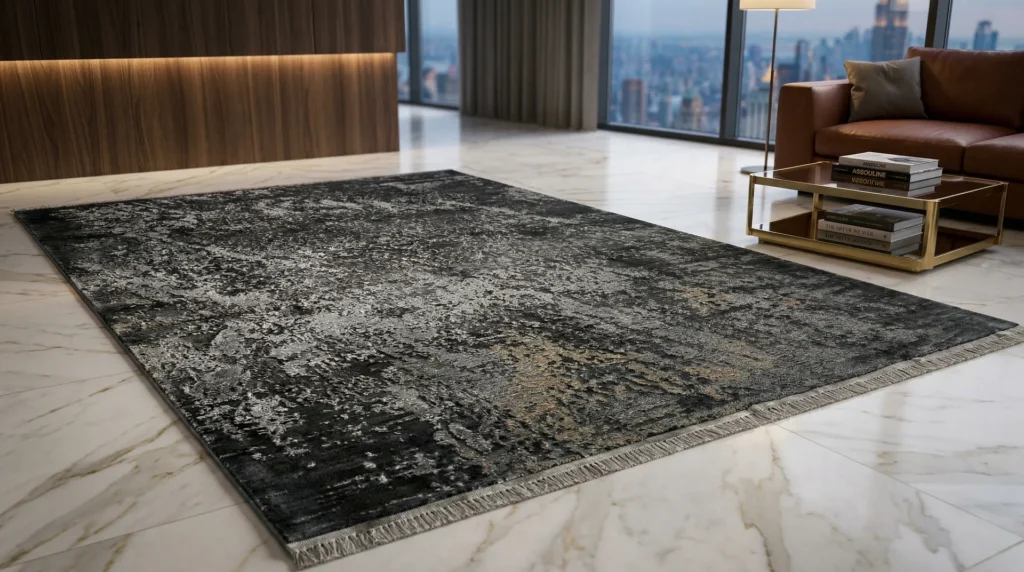
The most common mistake when buying a rug is not the colour or the material — it is the size. A rug that is too small cheapens even an expensive interior: the furniture stands apart from it, the room falls into fragments and the sense of unity disappears. This guide gives you exact measurements and placement schemes for every room, so you know precisely what size rug your home needs.
In short: the right rug size in 2 minutes
- Living room: go for 200×300 or 240×340 cm — at least the front legs of the sofa should sit on the rug.
- Bedroom: 160×230 cm or larger, placed crosswise under the bed so the rug extends 60–70 cm beyond it.
- Dining room: the rug must extend 60–70 cm beyond the table on every side, so chairs stay on it even when pulled out.
- Golden rule: when in doubt, size up — a rug that is too large always looks better than one that is too small.
- Leave 20–30 cm of bare floor between the rug and the walls.
Rug size chart by room
| Room | Recommended size | Minimum |
|---|---|---|
| Living room | 200×300 or 240×340 cm | 160×230 cm |
| Bedroom | 160×230 or 200×300 cm | 140×200 cm |
| Dining room | table + 60–70 cm on each side | 200×300 cm |
| Hallway | runner 80×200 – 80×300 cm | 67×200 cm |
| Kids room | 160×230 cm | 120×170 cm |
| Terrace and balcony | seating area + 30 cm | 120×170 cm |
Living room: three placement schemes
The right living room rug size depends on how you want to connect the furniture to the rug. Designers use three classic layouts.
1. All legs on the rug
The sofa, armchairs and coffee table sit entirely on the rug. This is the most luxurious arrangement and calls for a rug of 240×340 cm or larger. Ideal for spacious living rooms and open-plan homes, where the rug defines the seating zone.
2. Front legs only
The most versatile option: the front legs of the sofa and chairs rest on the rug, the back legs on the floor. It works beautifully with a 200×300 cm rug and visually ties the furniture together without the cost of an oversized piece.
3. Floating under the coffee table
A smaller rug, for example 160×230 cm, sits under the coffee table separate from the furniture. This only works if the rug is large enough not to look like a postage stamp in the middle of the room — its edge should reach almost to the front line of the sofa. Browse our modern rugs for a suitable pattern and tone.
Bedroom: the rug should extend beyond the bed
In the bedroom the rug has one simple job: a warm, soft first step in the morning. Place it crosswise under the bed, roughly two thirds of the way along, so it extends 60–70 cm on both sides and at the foot.
- 140 cm bed → 160×230 cm rug
- 160 cm bed → 200×300 cm rug
- 180 cm bed → 240×340 cm rug
An alternative for a smaller bedroom: two narrow runners on either side of the bed. You get a soft floor exactly where you step in the morning, without the price of a large rug.
Dining room: measure with the chairs pulled out
The dining room rule is strict: chairs must stay on the rug even when pulled away from the table. Add 60–70 cm to the table dimensions on every side. A 90×160 cm table therefore needs at least a 220×290 cm rug — in practice, 240×340 cm. Under a round table, choose a round rug by the same rule: table diameter + 120–140 cm.
For dining areas, prefer a low or medium pile — chair legs glide smoothly and crumbs are easy to remove.
Hallway
Narrow spaces call for runners 67–80 cm wide. Leave 5–10 cm between the rug and the wall on both sides — the corridor will feel wider. Length is simple: the runner should cover about 80 percent of the hallway.
Kids room
In a child’s room the play area sets the size: 120×170 cm covers a small play corner, while 160×230 cm creates a proper soft zone in the middle of the room. Choose a dense, easy-to-clean material — a kids room rug has to survive both games and spills.
Terrace and balcony
In summer the home extends outdoors. For a terrace or balcony seating area, choose an outdoor rug that extends about 30 cm beyond the furniture. Outdoor rugs shrug off moisture and UV light and turn even a small balcony into a room of its own.
Five common rug size mistakes
- A rug that is too small. Mistake number one. If the rug floats alone in the middle of the room and no furniture leg reaches it, the interior looks unfinished.
- Measuring only the table. In the dining room people forget the chairs — and six months later the chair legs are fraying the edge of the rug.
- Wall-to-wall placement. With no bare floor left, the framing effect disappears. Leave 20–30 cm of breathing room.
- A rug too thin for heavy furniture. Sofa legs leave permanent dents in a thin rug. Under heavy pieces, choose a dense weave.
- A large pattern in a small room. The smaller the room, the calmer the pattern. Bold geometry needs space to work.
Frequently asked questions
Can the rug be bigger than recommended?
Yes. As long as at least 20 cm of bare floor remains by the wall, a bigger rug is almost always the better choice.
How much space should be left between the rug and the wall?
The rule of thumb is 20–30 cm. In a small room 15 cm is enough; in a spacious one you can leave up to 45 cm.
Do rugs in different rooms need to match?
Strictly speaking, no — but a shared palette or style makes the home feel whole. For a consistent look, choose rugs from the same collection.
Summary
The right rug size is a simple formula: big enough in the living room for the furniture to reach it; big enough in the bedroom for your morning step to land on something soft; big enough in the dining room for the chairs to stay on it. Measure the room, tape the outline of the future rug on the floor with masking tape and look at the result — this five-minute test prevents an expensive mistake. Then pick your model from our rug collection or read on about the craftsmanship behind handmade rugs.